
Regulation Before Information
Why presence may be the most powerful health intervention we have in the birth world

A lesson I’ve been returning to lately in working with mothers and mothers-to-be is this:
Regulation matters as much as (and often more than) information.
We are living in an extraordinary time. Knowledge is more accessible than ever before. Mothers can learn about mineral depletion, nervous system science, minimal-intervention birth, co-regulation in sleep, breastfeeding physiology, trauma resolution, cycle awareness- all within seconds.
Google has answers, ChatGPT has protocols.
This is powerful… and long overdue.
And yet, I’ve been sitting with women every week who are quietly drowning in it.
Not because the information is wrong.
But because their nervous systems are overloaded.
When Information Becomes Too Much
It isn’t only that information sometimes “doesn’t stick” when there is too much coming at her…
At the wrong moment, in the wrong state, it can actually tip a mother into further dysregulation regarding the choices she has or the action that can be taken- whether she’s trying to conceive, navigating pregnancy and birth decisions, or finding her footing in postpartum.
I don’t say that to alarm. I say it with a call to reverence.
Because in maternal & family health spaces, the way we deliver information matters.
A nervous system that feels safe can metabolize information and complexity.
A nervous system that feels threatened may interpret even helpful information as pressure.
Take breastfeeding as an example.
I am an advocate for breastfeeding- and for me it goes beyond the evidence, it feels personal and universally beautiful in ways. But I have watched how early, high-pressure messaging- even when evidence-based- can leave a mom heading into postpartum feeling as though her worth as a mother hinges on breastfeeding success. And have even seen there are circumstances in which pursuing it does not serve the mother-baby dyad.
When exhaustion, hormonal shifts, healing tissues, and identity transitions are all happening at once, more facts aren’t always what’s needed first. Often what allows breastfeeding success later is something quieter: stabilization, reassurance, steady presence.
The sequencing matters.
Not because information is bad, but because human physiology has a real effect on outcomes.
The Missing Ingredient: Context + State
I’m coming to understand my role with clients less as a distributor of knowledge and more as a steward of space.
Information is one tool, context is another, and a mother’s state in the moment is the foundation beneath both.
Sometimes the “ideal” recommendation- the most optimized path- is not what serves that nervous system right now. Sometimes the wisest next step is the one that preserves steadiness in that foundation, even if it looks less perfect on paper.
And then we can make a plan, which unfolds at a pace her body can tolerate; this is not about lowering standards for health outcomes. It is about honoring her biology.
The Birth Decision Fog
Recently, I watched a client wrestle with conflicting perspectives from her providers about cesarean versus vaginal birth.
Her providers were thoughtful and well-intentioned. Each one spoke from training, research, experience, personal tolerance for risk, cultural moment they are embedded in, and professional lens.
Neither of them were wrong, but she was frozen in-between them.
Not because she lacked intelligence to understand their perspectives. But, because her system was overwhelmed.
Pregnancy naturally sensitizes the nervous system; it prepares a mother to attune deeply to her baby. That same sensitivity can make her exquisitely vulnerable to information overload as she seeks to protect that which is most precious… new life.
What she needed first was not another statistic about baby’s size, the accuracy of ultrasound, or back-up plans.
She needed space for everything she was sensing to settle: the providers’ tones, the stories she’d heard from friends, her own hopes and fears, the unknown variables no research paper could account for that are nested within her unique family & ancestral system…
So that in greater stillness- even if just for a passing moment- she could access her own budding mechanisms for knowing.
Because a mother’s knowing is rarely just logic…
It includes:
Her body’s cues
Her family system
Her relational dynamics
Her history
Her capacity
Risks that statistics can’t personalize
Future implications only she can weigh
Information is part of discernment, but discernment is larger than information.
And it cannot be rushed.
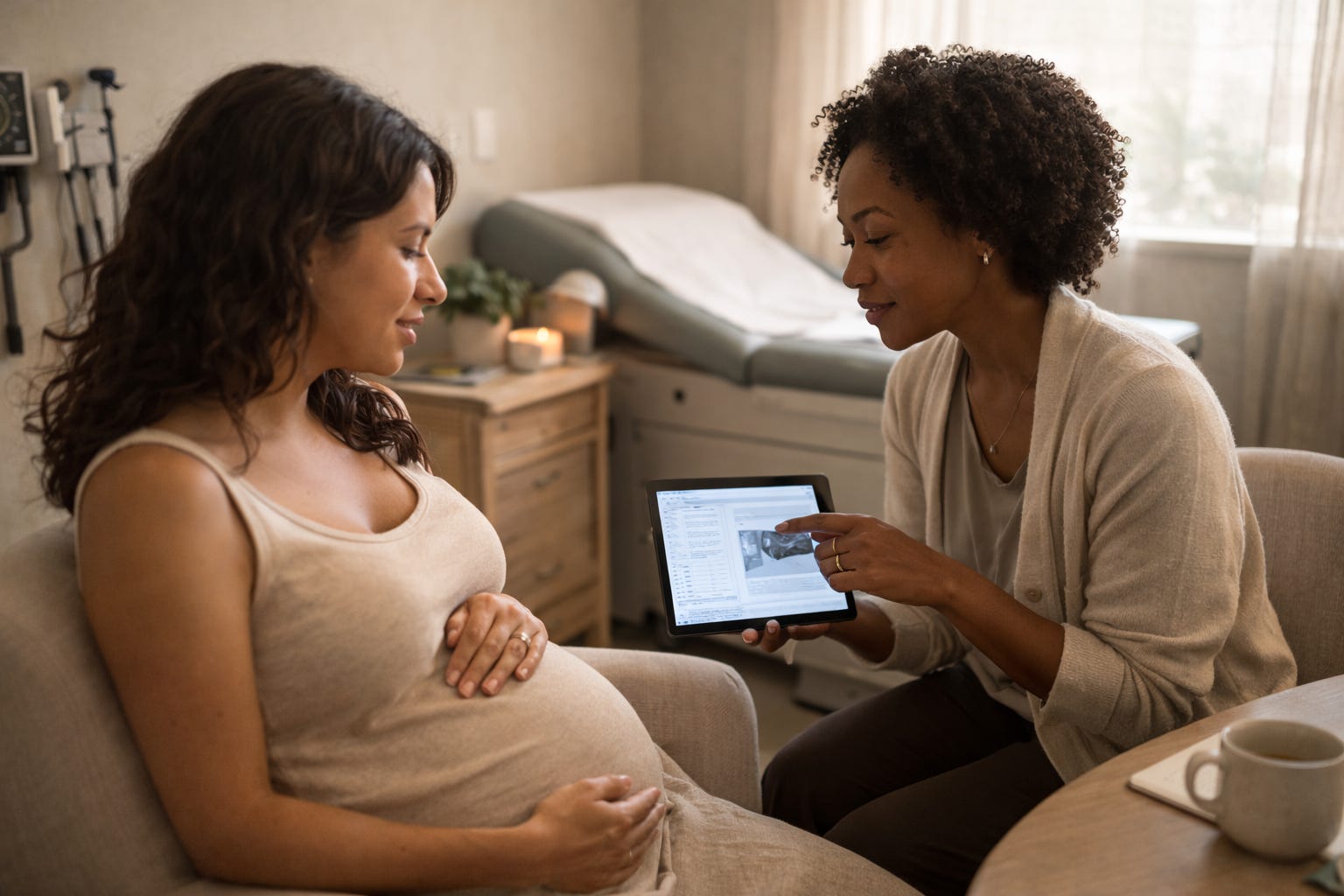
Conversations about lowering unnecessary cesarean rates and improving birth outcomes are important and should remain ongoing. And at the same time, research across birth trauma and perinatal mental health suggests that a mother’s sense of agency, safety, and integration may be just as influential in her long-term well-being as the clinical pathway, itself.
When given space to process fully, a mother can cultivate her birth plan in a way she’s congruent with as the matriarch in her family’s journey to well-being.
The Gap in Our System
Our healthcare system is extraordinary in many ways. It saves lives daily.
But it is not structured for time-intensive co-regulation and parent’s discernment.
Appointments are brief. Systems are strained. Efficiency is necessary.
Even the most compassionate physician often cannot provide the kind of steady relational presence that allows complexity to soften and integrate.
And yet- we know continuous support makes a measurable difference.
Large systematic reviews of birth and postpartum doula support show associations with:
Lower cesarean rates
Shorter labors
Reduced use of certain interventions
Higher satisfaction with the birth experience
Increased likelihood of breastfeeding initiation
Lower reports of postpartum anxiety and stress
These outcomes are consistently documented in peer-reviewed research on the benefits of continuous support… of continuity of care.
I suspect one powerful factor is:
Steady presence allows physiology to settle.
When physiology settles, decision-making changes.
Confidence changes.
Integration changes.
Even pain perception changes…
A Word to Birthworkers
I want to speak gratitude and encouragement to all birthworkers in maternal health spaces- fertility specialists, pregnancy coaches, midwives, OBs, lactation consultants, doulas, nurses, childbirth educators, and more.
Those who are actively tending the relational spaces in between conventional healthcare with steady presence and continuity of care…
You are helping shape a future in which relationship-based care becomes not the exception, but the standard.
And may this be a gentle reminder that the sequence in which we offer information to the mothers and families we serve, matters.
Information delivered into a dysregulated nervous system can increase challenge- not because it is inaccurate, but because it intensifies pressure.
This does not ask for perfection from us.
But it does invite reverence.
Before we educate, we can attune.
Before we optimize, we can stabilize.
And when we mis-sequence- when enthusiasm moves faster than attunement- repair is possible.
That is one of the quiet strengths of relational work.

Because these in-between fields can be inherently more relational, we are given something rare: the time and proximity to remain aware of how our preferences or knowledge can subtly shape delivery. To notice dysregulation and to adjust with humility.
When we approach our work from steadiness, we can meet mothers and fathers in their unfolding wisdom- not ahead of it, not behind it- but alongside it, supporting their emerging well-being.
A Word to Mothers
If you feel overwhelmed by conflicting advice or information overload, that is not a personal failure. It is a nervous system doing exactly what it evolved to do under perceived threat- especially as you guard something so precious.
As you seek providers and support, notice something simple:
Do you feel more settled after speaking with them?
Or more agitated?
Your body’s response matters.
Meet the therapists, coaches, doulas, lactation consultants, midwives, providers in your area. Interview a few. Find the person whose presence steadies you when you ask questions.
Increasingly, services for fertility, lactation, and doula services are accessible through benefits such as Carrot or Maven, and sometimes even through reimbursement through insurance.
I hope this is a reflection of a growing opportunity for continuity of care to exist, even within our current healthcare system optimized for short appointment times and efficiency.
You deserve support that helps you think clearly- not just think more.
Why Continuity Matters
This is why I have hope for the expanding relational threads within maternal healthcare- including the evolution of the doula field, which I’ve learned began in birth in the 1970s, expanded into postpartum in the 1990s, and more recently has expanded into fertility.
In getting to know this field more intimately, I’ve come to see that doulas have been quietly extending more than steady presence. Some have been weaving referral networks of local, relationship-based healthcare providers- creating continuity across a journey that can otherwise feel segmented.
It feels like a co-evolution. Like the extension of a mycelial network beneath a forest floor.
In a fragmented and highly specialized healthcare forest, many doula networks are forming an underground connective tissue- allowing information, local resources, and relational safety to travel across disciplines in their communities.
As maternal healthcare grows more technologically advanced, relational continuity becomes even more essential.
Not to replace medicine.
But to stabilize the space in which medicine operates even as new systems continue to emerge.
A steady presence through fertility, pregnancy, birth, and postpartum creates room for discernment.
It can allow mothers to integrate research with intuition, statistics with story, optimization with humanity.
It restores a gentler pacing- one that ripples outward into family well-being.

A Heart’s Wish
Today, there is a clear heart’s wish within me that goes out with this newsletter:
May the art of presence and continuity grow stronger in our existing maternal health spaces.
May mothers (and fathers) be lifted in the power of their discernment and steadiness- a capacity that will continue to serve them as they grow their families.
May the tools, people, and services they need become available to them both within, and external to, our current systems.
May their families flourish toward sustainable well-being.
May providers, and caregivers across the birth world move with awareness for the nervous systems entrusted to them.
And to all of us: may we build systems that nurture mothers in body, mind, and spirit.
If this resonates, I would love for you to join me in sending that same wish outward to our families.
And, I’d love to know… where do you see relational continuity already growing in maternal healthcare? And where do you feel it’s still most needed?
I would love to start a conversation in the comments :).